Japanese tea pairing beginner’s guide
Basic methods & ideas for impressive food paring
Quality Japanese tea has full of potentials.
Green, smooth, umami, kick of bitterness, clean aftertaste.
If you are thinking about non-alcohol paring with your foods, you must consider Japanese tea as one of the best options.
However it might be complicated to find the right product without knowledge.
We simplify the methods for the paring ideas for beginner.
Basic concept of pairing
In short pairing is based on two perspectives.
-Assimilation (same)
-Contrast (different)
You choose element with intentions.
For example, matcha with watermelon juice is popular.
This is explained by assimilation.
The strength and green flavors of both matcha and watermelon are perfectly matched.
Eating apple pie with black tea is explained by assimilation and contrast.
Some ripe fruity aroma of black tea are harmonized with baked apple (assimilation).
Greasiness of butter is cut by astringency of black tea (contrast).
Basic taste & flavor of Japanese tea
Majority of Japanese tea is steamed green tea, while Chinese green is pan fired.
The difference of processing create the uniqueness of Japanese tea.
It’s like mentality of Japanese people who appreciate the freshness and quality ingredients.
煎茶 Sencha
Orthodox Japanese leaf tea.
For some quality sencha there are unique floral, fruity aromas as cultivars.
Basic flavors of sencha are green note.
Balance of umami, sweetness, bitterness, astringency.
Since the tea is popular among Japanese people it’s easy to pair with traditional Japanese food like sushi, tempura etc.
-Green (vegetal, grass, herb)
-Roasty (sweet corn like)
玉露 Gyokuro & 抹茶 Matcha
Shade the tea trees before harvesting like 14 days.
Rich sweetness and umami, low bitterness.
There are unique shaded aromas called 覆い香 Ooika, which is similar as dried nori seaweed.
-Seaweed (from shaded tea like gyokuro, matcha)
-Roasty (sweet corn like)
焙じ茶 Houjicha
Roasted tea.
Normally used low quality sencha.
But if the material is better, it creates more complexity aroma and taste.
-Nutty
-Roasty
-Savory
京番茶 Kyo bancha
Type of affordable tea which is drunk among local people.
This tea is made of large leaves and has strong smoky aromas.
-Smoky
発酵茶 Fermented tea
In upcountries there are rare types of tea which was traditionally made.
The smell is sour because of lactic acids fermentation.
-Sour like vegetable pickles
-Earthy
和紅茶 Wakoucha
Japanese style black tea.
Since using Japanese cultivar the flavors are gentle, mild, round, light water color.
These days the quality is improving.
-Honey
-Sweet potato
-Apple
Approach to create food pairing with Japanese tea
The flavors of tea is changed by extraction.
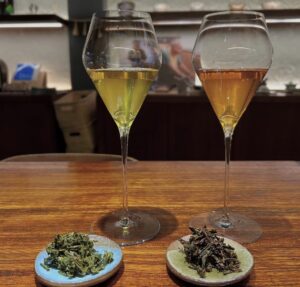
So we highly recommend for beginner to brew with cold brew.
For example, put 10g of leaf in bottle, put 500g of filtered water (soft water).
Leave one night in fridge, then filter next morning.
Step1. Choose candidate of tea
Analyze the tea taste and flavor.
You write down whatever you feel by drinking the tea.
The more information you get, it’s easier to find the candidates of ingredients.
Step2. Choose ingredients
Since the flavor of Japanese tea is delicate cooking can be similar style like utilizing ingredients taste.
Therefore traditional Japanese foods are easy to pair.
For thicker taste like western, Chinese, Thai cuisine, need some adjustments.
For example, using fermented tea to cut oiliness, reduce the thickness of foods for balancing.
Step3. Try to pair foods with Japanese tea
You check the impression.
Personally we like to taste this flow.
1. Tea
2. Food
3. Tea
First check the original impression of tea and food.
Then see any difference by drinking tea again.
If pairing is successful, you might feel harmony or new flavor is outlined.
Harmony is because some elements are matching and balance is good.
Outline is because similar elements are muted in each other, then feel other elements clearly.
Paring examples
There are many potentials of parings with Japanese teas.
We can suggest some based on our experience.
Example 1. White fish meat and sencha
Japanese fish and Japanese tea are well matching.
Especially white meat fish like sea beam.
When we tasted sea beam sashimi with cold brew Yabukita sencha, it’s perfect harmony.
The marine flavor is synchronized with green aroma of tea.
Create long lasting with different types of umami (Inosinic acid from fish and glutamic acids of tea).
Example 2. Sea weed and gyokuro
Quality gyokuro has rich seaweed aromas with strong umami.
It’s easy to pair with foods with deep green, seaweed flavors, rich taste.
When collaborating with one tempura restaurant, the Japanese chef serve fried seaweed topped with sea urchin.
We served gyokuro.
1st brew enjoy the drink with small amount.
2nd brew with hotter temperature with larger amount of water.
Extract more bitterness to cut greasiness of oil.
The other examples
There are possible examples for paring with Japanese tea.
-Parmigiano cheese & Kyo bancha (smoky)
-Custard cream & Matcha(rich, green, umami)
-Wagyu steak with red wine sauce & Awa bancha (cut oil with sourness)
-Bonito broth with soy sauce & Houjicha (some houjicha is savory like dried bonito)
-Grilled pork with honey sauce & Wakoucha (cut oil and harmonized with honey like sweet note).
We suggest Japanese tea matching your foods
Feel free to contact us for consulting.
Based on our knowledge and practice we recommend pairing ideas.